 Sardines
Lisbon's Tin Shops: A Collector's Pilgrimage
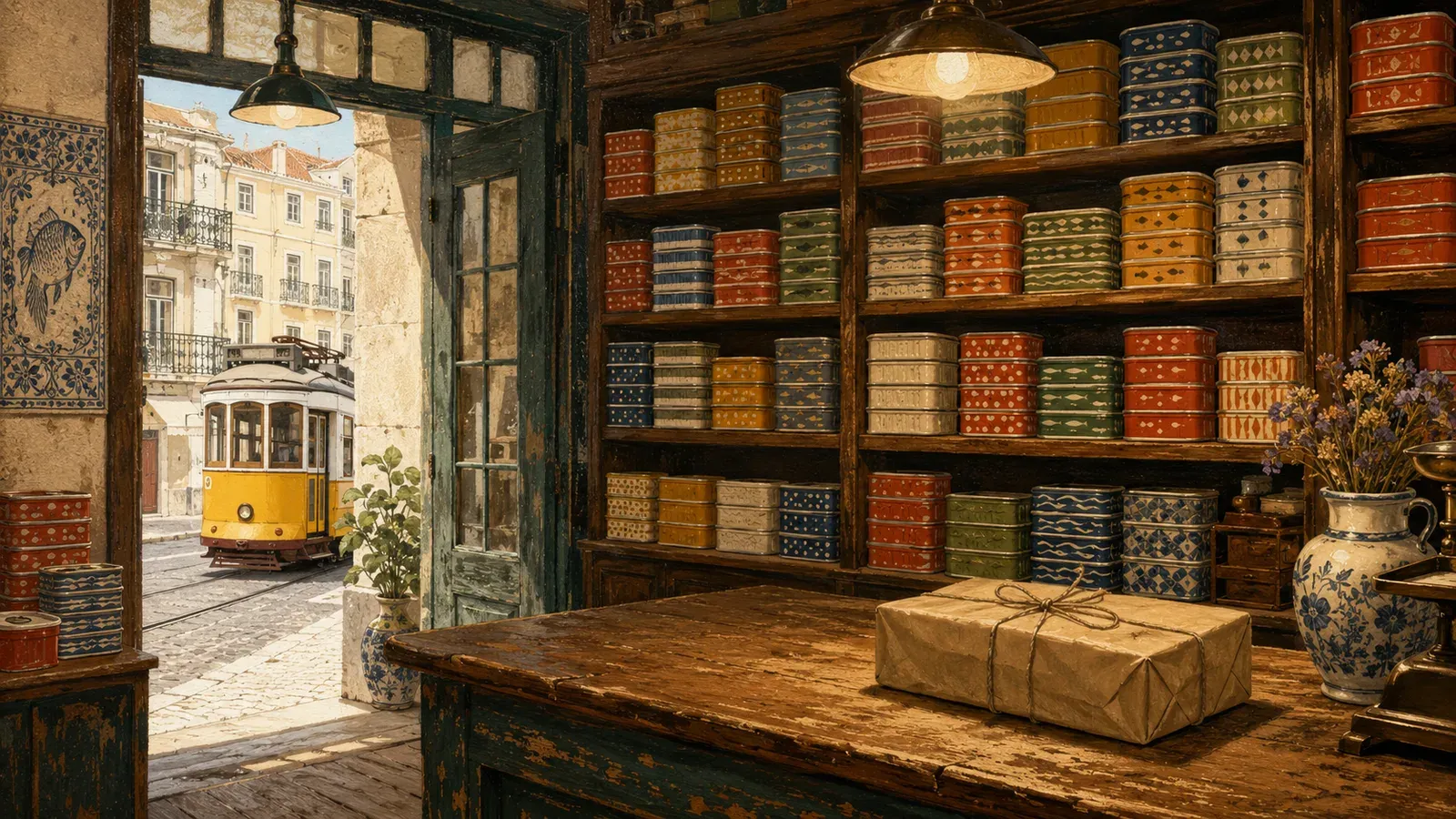
Lisbon is the only city I know where canned fish has temples. Three of them, all within a short walk in the old downtown: Conserveira de Lisboa, where your tins are wrapped in paper and tied with twine at a wooden counter that hasn't changed since 1930; Loja das Conservas, where seventeen canneries each get a shelf and a history lesson; and O Mundo Fantástico da Sardinha Portuguesa, a circus of birth-year tins. I visited all three on one trip, camera in one hand and an emptying wallet in the other. This is what I found, what I bought, and where I'd send you first.
Most cities put their treasures behind glass. Lisbon stacks its national treasure to the ceiling in tins, prices it under three euros, and wraps it in paper for you. For a sardine collector, walking the Baixa is what walking the Louvre must be for a painter — except here you can take the exhibits home and eat them.
Conserveira de Lisboa: the ritual
Start at Rua dos Bacalhoeiros 34, a few streets back from the river. Conserveira de Lisboa opened in 1930 as a grocery called Mercearia do Minho, found that the tins were outselling everything else, and renamed itself around them in 1942. The same family — the Ferreiras — have run it for three generations, and it shows: the dark wooden shelving and counter feel closer to an apothecary than a shop.
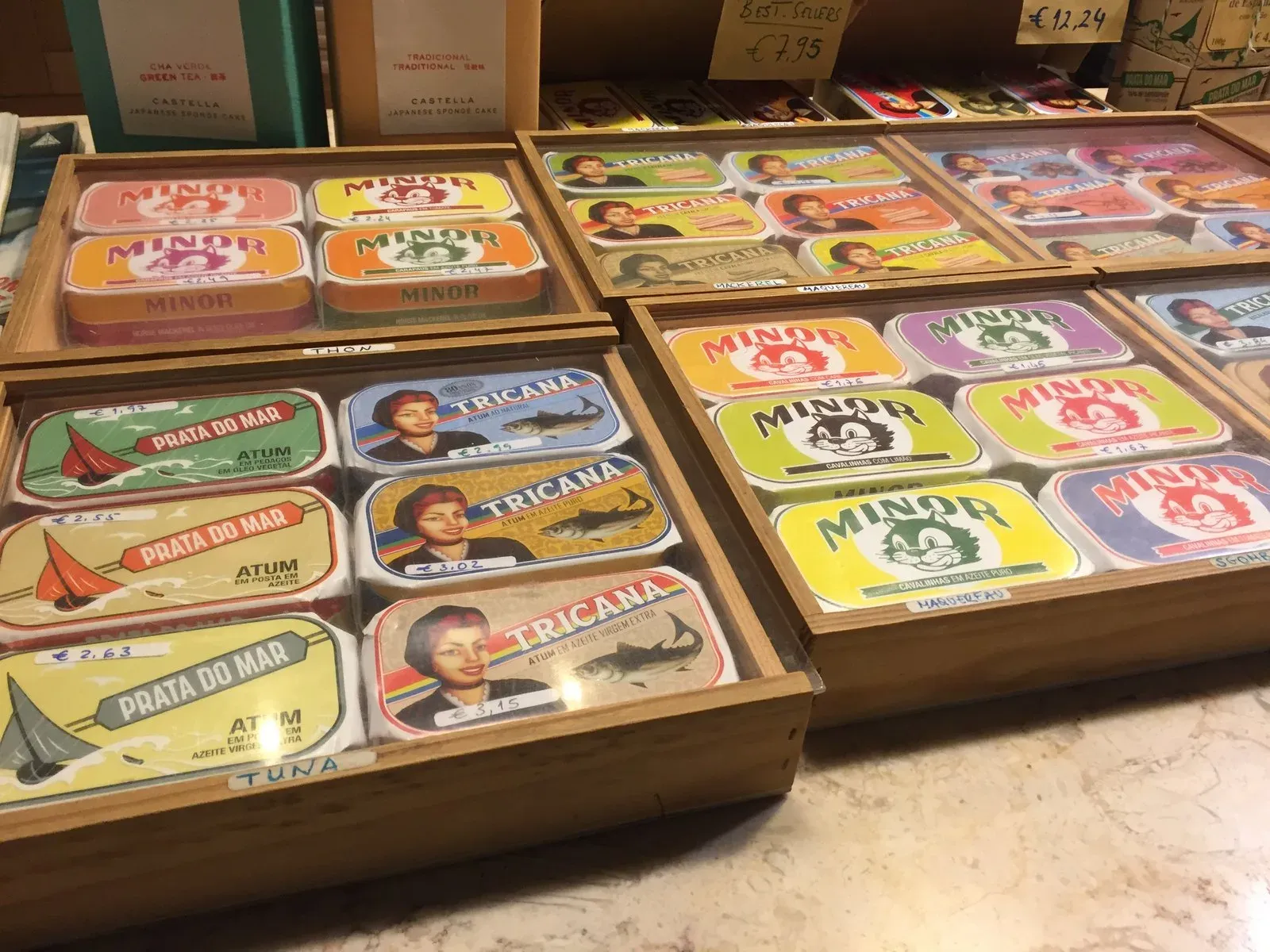
They sell only their own three house brands, and the trays on the counter teach you the range faster than any catalogue. Tricana — the woman in the headscarf — is the flagship: sardines, tuna, mackerel in olive oil. Minor — the winking cat — covers the small tins, little mackerel and petinga at pocket prices. Prata do Mar — the sailboat — rounds out the line. My photos from the counter show the prices, and they are the quiet scandal of the place: hand-packed cavalinhas from €1.45, Tricana tuna in extra virgin olive oil at €3.15. In a world of €12 designer tins, that is a gift.
The real product, though, is the last thirty seconds. You hand over your tins, and the shopkeeper wraps the stack in paper, folds the ends sharp, and ties the parcel with coloured twine — the same gesture, I'd guess, performed millions of times since 1930. Watch it once and you will not leave without a parcel of your own.
Loja das Conservas: the library
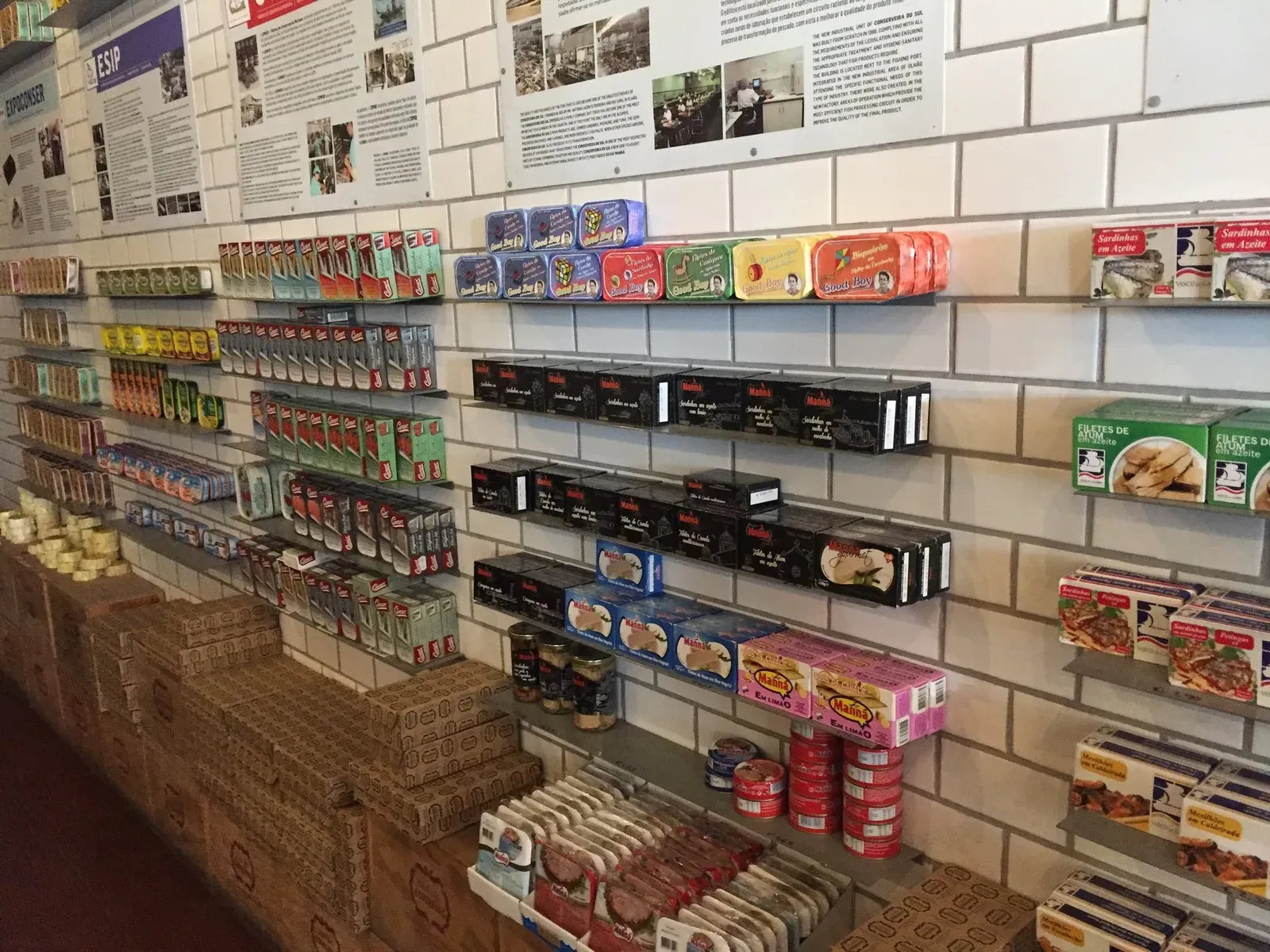
Ten minutes west at Rua do Arsenal 130, near Cais do Sodré, the concept flips. Loja das Conservas — opened in 2013 and run by the national association of fish canners — is not one cannery's shop but the whole industry's showroom. Seventeen Portuguese canneries each get their own stretch of white-tiled wall, their tins on the shelf and their story on a panel above it: founding dates, factory photos, the lot.
This is where I understood how deep Portuguese canning goes. Good Boy's kite-and-Rubik's-cube tins from Conserveira do Sul next to Manná's black-and-gold line; Vasco da Gama; brands produced only for export that you will not find in a Portuguese supermarket. The panels turn browsing into reading — I spent longer here than in either other shop, and my photo of that wall is one of my favourites from the whole trip. Look for La Gondola's aged sardines, rested in olive oil for a year before sale, the tinned-fish equivalent of cellared wine.
If Conserveira de Lisboa is a chapel, this is the library. Come here to fill gaps in a collection; it is the single densest room of sardine brands I have ever stood in.
O Mundo Fantástico: the circus
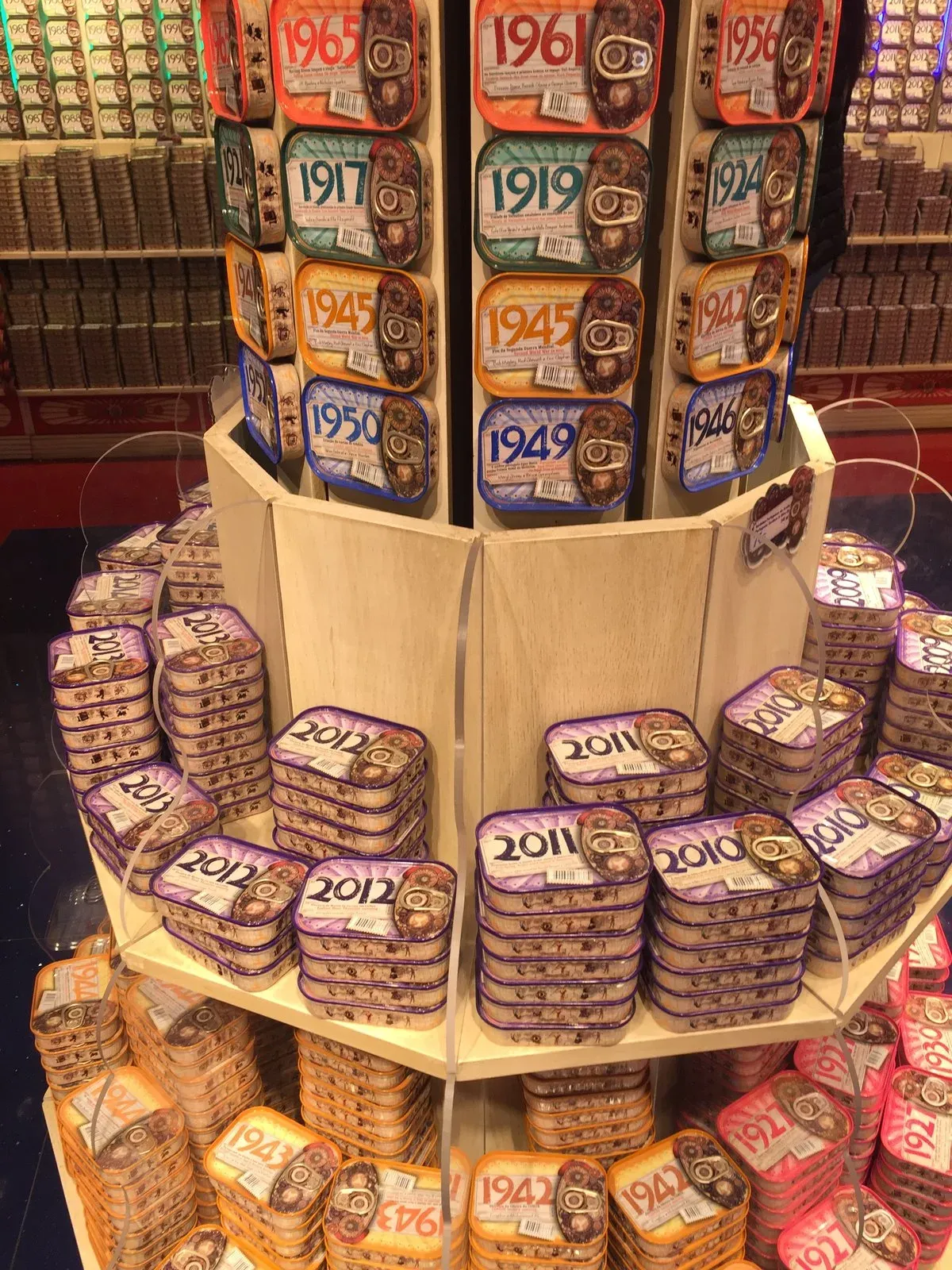
And then there is the one your friends who don't care about sardines will drag you into. O Mundo Fantástico da Sardinha Portuguesa — The Fantastic World of the Portuguese Sardine — is Comur's flagship spectacle: red carpet, carnival lighting, Ferris-wheel displays, and a carousel of tins printed with every year from 1916 to the present, each carrying the events and famous names born that year. Find your birth year, find your mother's, walk out with a heavier bag and a lighter wallet.
Let me be the collector in the room: you are paying for packaging. Comur, founded in 1942 in Murtosa, cans perfectly good fish, but the year-tin is a keepsake with sardines in it, at a keepsake price — several times what the same weight of fish costs across town. And yet I photographed that tower of tins like everyone else, because as pure theatre it is wonderful, and no other food on earth gets this treatment. Nobody builds a circus for tinned tuna.
My rule: buy one — your year, someone's gift — and then take your remaining euros to the other two shops where the fish, not the box, is the point.
The story behind the theatre
After this guide was published, someone from the company behind O Mundo Fantástico wrote to us. Not a complaint. A correction of emphasis, and it deserves space here.
We called the carousel "pure theatre". Sónia Santiago, who leads marketing and cultural communication for Grupo O Valor do Tempo, the group behind the shops, told us the theatre is not the point. It is the front door.
Behind it is Comur, a cannery founded in 1942 in Murtosa, on the Aveiro lagoon, where it began by preserving the local fried-eel escabeche of the "fritadeiras da Murtosa". Today about 100 women still work the fish by hand there, keeping a craft the company did not want to see disappear in silence. The industry they belong to was once the second most important sector of the Portuguese economy. It shaped towns, factories and whole generations. The fantasy in the shops, in her words, was the language the group chose to make people look at that reality: a visitor who takes home a tin is carrying a piece of that history, not just packaging.
We stand by what we wrote. The carousel IS theatre, and it is glorious. But she is right that the show has a spine, and it is made of eighty years of hands. It is the reason the tins say 1942 somewhere under all that colour.
With thanks to Sónia Santiago of Grupo O Valor do Tempo for the account of Comur's history, quoted with permission.
One more stop, and a confession
If the tins have made you hungry, finish at Sol e Pesca, Rua Nova do Carvalho 44 — a former fishing-tackle shop in Cais do Sodré, rods and reels still on the walls, where the menu is the shelf: pick a tin, and they serve it open with bread, and a glass of wine. It is the missing piece of the pilgrimage — the place where the souvenir turns back into supper.
The confession: I came home with more tins than any reasonable person needs. Some of them are on my shelf still. The rest did what sardines are for.
The pilgrim's route: Conserveira de Lisboa for the ritual, Loja das Conservas for the range, O Mundo Fantástico for one birth-year tin and the photographs, Sol e Pesca to eat. All four are within a twenty-minute walk in the old downtown.
Sources & further reading
- All shop photographs are my own, taken on my visit.
- Conserveira de Lisboa — official history (1930 founding, Ferreira family, house brands)
- Loja das Conservas — about (ANICP official store, 17 canneries, Rua do Arsenal 130)
- O Mundo Fantástico da Sardinha Portuguesa — official site (Comur, 1942, year tins 1916–present)
- PRIOR — Tin Town: Lisbon's conservas shops (addresses, wrapping ritual, La Gondola aged sardines)
- Fathom — Sol e Pesca (former tackle shop, Rua Nova do Carvalho 44)
Frequently asked questions
What is the best canned fish shop in Lisbon?
It depends what you are after. Conserveira de Lisboa (Rua dos Bacalhoeiros 34) is the classic — a 1930s shop where your tins are wrapped in paper and tied with twine. Loja das Conservas (Rua do Arsenal 130) has the widest range, with seventeen Portuguese canneries each given their own shelf. O Mundo Fantástico da Sardinha Portuguesa is the theatrical one, built around birth-year souvenir tins.
What are the sardine tins with years on them in Lisbon?
Those are Comur's birth-year tins, sold at O Mundo Fantástico da Sardinha Portuguesa. Each 140g tin is printed with a year from 1916 onward, plus events and famous people born that year. You pay for the keepsake packaging — the sardines inside are ordinary good Portuguese sardines — so treat it as a souvenir, not a pantry buy.
How much do sardines cost in Lisbon?
At Conserveira de Lisboa I photographed everyday tins from about €1.45 for small mackerel to around €3 for tuna in extra virgin olive oil — remarkably reasonable for hand-packed fish. Souvenir-oriented shops charge several times that for decorated tins. Supermarket sardines run cheaper still, but the shop tins are a different product.
Can you bring canned sardines home in your luggage?
Yes — commercially canned fish is shelf-stable and generally fine in checked luggage. Tins over 100ml count as liquids for carry-on in many airports, so pack them in the hold. Rules on animal products vary by destination (the US and EU generally allow canned fish for personal use), so check your own country's customs page before stocking up.
Is O Mundo Fantástico da Sardinha worth it?
As a spectacle, absolutely — it is a circus-themed shrine to the sardine and costs nothing to walk through. As a purchase, know what you are buying: beautifully packaged souvenir tins at souvenir prices. If you want the best fish for your money, buy your keepsake tin here and do your real shopping at Conserveira de Lisboa or Loja das Conservas.