 Sardines
Sardines vs. Anchovies: What's the Difference?
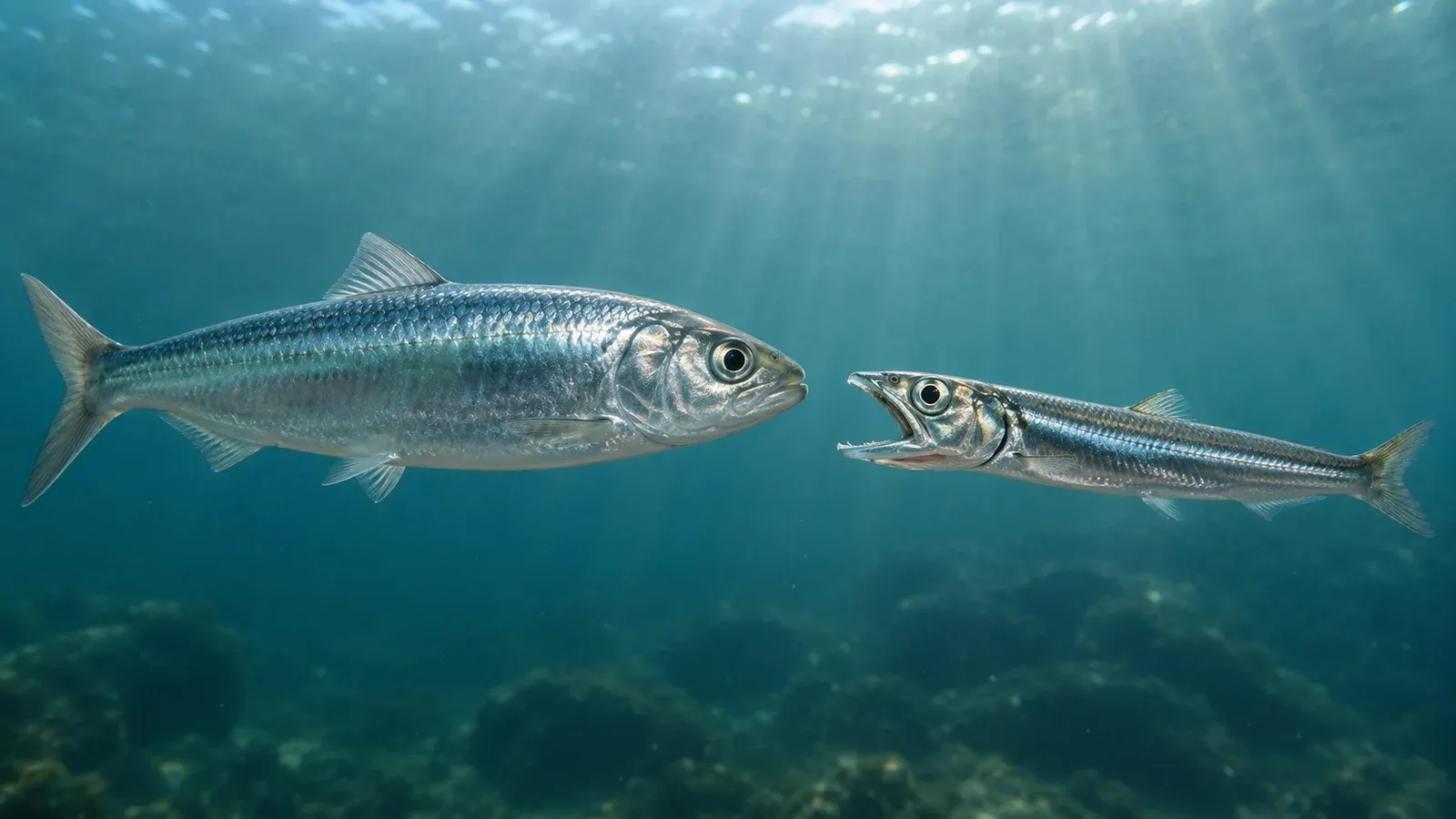
The short answer: no, anchovies are not sardines — they're different families of fish, and the famous anchovy flavour isn't the fish at all. It's the cure. Here is how to tell the two apart on the shelf, in the water, and on your tongue, with the measured numbers for both.
Cousins, not siblings
Both are small, silvery, oily fish that swim in huge shoals and get packed into small tins — which is where the confusion starts and, for most people, never ends. Taxonomically the split is clean. Sardines belong to the herring family, Clupeidae: the European pilchard, the Pacific sardine, the sardinellas. Anchovies are an entirely separate family, Engraulidae, over a hundred species strong, from the European anchovy on Mediterranean coasts to the Peruvian anchoveta — the most heavily fished species on Earth. Same order of fishes, different families: cousins, not siblings, and never interchangeable on a label. The word "sardine" can legally cover some twenty herring-family species depending on the country — an anchovy is never one of them.
The mouth gives it away
Put the two side by side and one feature settles it instantly. A sardine has a neat, forward-facing mouth on a fish that typically runs 15–20 cm. An anchovy is smaller — rarely past 15 cm — and carries a huge, underslung mouth beneath an overhanging snout, with a jaw that extends back well behind the eye. It gives the anchovy a slightly cartoonish, big-mouthed profile that, once seen, is never confused again. That mouth is a feeding tool: anchovies swim open-mouthed through clouds of plankton like tiny basking sharks.
The cure is the flavour
Here is the part that rearranges how most people think about both fish. The "anchovy taste" — that dark, salty, umami intensity — is manufacturing, not biology. The classic anchovy fillet is salted and left to cure for months; the flesh ferments, deepens to reddish-brown, and concentrates into the flavour bomb that dissolves into puttanesca and Caesar dressing. A fresh anchovy tastes nothing like that: mild, clean, faintly sweet. Spain marinates fresh ones in vinegar as boquerones — white, delicate, and routinely mistaken for a different species by people who only know the pizza kind.
Sardines take the opposite road: caught and processed fresh, cooked in the tin, never fermented. That's why a tin of sardines is dinner and a tin of anchovies is a condiment. Two fish, two processing philosophies, one shared shelf.
The numbers, side by side
Per 100 g, canned in oil and drained (USDA-derived values):
| Sardines (with bone) | Anchovies (cured fillets) | |
|---|---|---|
| Protein | 24.6 g | 28.9 g |
| EPA + DHA omega-3 | 0.98 g | 2.06 g |
| Calcium | 382 mg | 232 mg |
| Vitamin B12 | 8.9 µg | 0.9 µg |
| Iron | 2.9 mg | 4.6 mg |
| Selenium | 53 µg | 68 µg |
| Sodium | 307 mg | 3,668 mg |
Read fairly, both columns are impressive — gram for gram, cured anchovies are one of the densest omega-3 foods you can buy, and their iron is excellent. But the table hides a portion-size trick: nobody eats 100 g of cured anchovies. A real serving is two or three fillets, about 12 g, which shrinks all those numbers — and mercifully, the sodium — by nearly ninety percent. Sardines are eaten by the tin, so their column is what you actually get: a complete protein, a third of your daily calcium in the soft bones, and nearly four days of B12, at a tenth of the salt. As an everyday staple, the sardine takes it. As a seasoning that makes everything else taste better, the anchovy has no rival.
How to use each one
Treat the sardine as the fish and the anchovy as the flavour. Sardines: on toast, over salad, straight from a tin worth choosing carefully, grilled whole in summer. Cured anchovies: melted into warm olive oil for pasta, laid across pizza, blitzed into dressings — one or two fillets, doing the work of a spice. And if you meet fresh anchovies at a market or as boquerones, take them: they're the missing link that makes the whole family make sense.
Different families, different mouths, different cures — and both worth keeping in the pantry. Eat the bones. (The sardine's, that is. The anchovy's dissolved in the cure.)
The pantry answer: stock both. Anchovies to make food savory; a few great sardine tins from our world ranking to make food, period.
Sources & further reading
- NOAA Fisheries — northern anchovy species profile (family Engraulidae)
- NOAA Fisheries — Pacific sardine species profile (family Clupeidae)
- NutritionValue — canned Atlantic sardine, drained, per-100g values
- FoodStruct — European anchovy, canned in oil, drained, per-100g values (USDA-derived)
- FAO — European anchovy (Engraulis encrasicolus) species fact sheet
Frequently asked questions
Are anchovies and sardines the same thing?
No. They are different families of fish. Sardines belong to the herring family (Clupeidae); anchovies are their own family (Engraulidae) with more than a hundred species. They are cousins at the order level — similar size, similar waters, similar shoals — but no anchovy is ever legally a sardine.
What is the difference between sardines and anchovies?
Three differences: the fish, the mouth, and the cure. Sardines are larger with a neat forward mouth; anchovies are smaller with a huge underslung mouth that runs back behind the eye. And they're processed oppositely — sardines are cooked fresh and canned mild, while the familiar dark anchovy fillet is salt-cured for months, which is where all that intensity comes from.
Which is healthier, sardines or anchovies?
Per 100 g, cured anchovies carry about twice the omega-3s and more iron, but also twelve times the sodium — 3,668 mg vs 307 mg. Sardines bring more calcium (their soft bones are eaten), ten times the vitamin B12, and are mild enough to eat by the tin rather than the fillet. As an everyday fish, sardines win; as a seasoning, anchovies are unbeatable.
Do anchovies taste like sardines?
Cured anchovies don't taste like sardines at all — the intense salty umami is the months-long salt cure, not the fish. Fresh anchovies taste mild and clean, much closer to a sardine; Spain's boquerones (fresh anchovies in vinegar) surprise everyone who only knows the pizza kind.
Can I substitute anchovies for sardines?
Not one-for-one. A cured anchovy fillet is a seasoning — one or two dissolve into a sauce. A sardine is a portion of fish. Swap sardines in where you'd eat the fish itself; swap anchovies in where you want salty depth. In a pinch, rinsed anchovy fillets can stand in for sardines in a pasta, but halve the added salt.